Who gets the last pallet? What AI’s challenge to ETH means for business
What AI’s challenge to the Exponential Time Hypothesis means for business optimization, and how a digital twin could help a distributor allocate scarce stock.
A distributor has one pallet left on Friday morning. A workshop ordered first and needs it by Monday. A shipyard ordered second and needs it today. Another pallet is due on Monday, in time for the workshop’s collection.
Automate the rule “reserve stock for the oldest order” and the software will set aside the last pallet for the workshop. The shipyard misses its deadline while the goods it needs sit on the shelf. Give today’s pallet to the shipyard instead, and both customers can get what they need, provided Monday’s delivery arrives on time.
That’s the difference between automation and optimization. Automation carries out the rule you gave it. Optimization compares the available choices against an outcome you care about. Here, that outcome is keeping both promises. Now imagine making that call across hundreds of orders, with partial deliveries, uncertain suppliers and customers who have paid for priority. You can recognize a good plan and still have too many possible plans to check by hand.
What is the Exponential Time Hypothesis?
In October 2026, OpenAI and Anthropic each reported that an internal AI model had found a way to beat a limit computer scientists had suspected for decades. The limit is called the Exponential Time Hypothesis, or ETH. Both labs published their arguments and versions that proof-checking software can check. Researchers, including the original authors of the hypothesis, opened the work to independent scrutiny. OpenAI’s research announcement, Anthropic’s paper and proof, The researchers’ public review
Think of a puzzle with yes-or-no choices. Each rule gives you three options, and at least one must hold. Can you make all the rules hold at once? Computer scientists call this puzzle 3-SAT. Ten yes-or-no choices give you 1,024 combinations. Twenty give you more than a million. Doubling the number of choices has squared the amount of work you’d do if you tried every combination.
ETH says something stronger than “trying everything takes ages.” It says that, for the hardest puzzles of this kind, even the cleverest exact method would still need time that grows at a fixed exponential rate or faster. The two labs describe methods whose worst-case running time eventually grows more slowly than any such rate. If the arguments hold, researchers can revisit limits on other problems that rested on ETH. OpenAI’s paper, Anthropic’s paper
These puzzles were always solvable given enough time. What may have changed is how much time an exact answer requires as the puzzle gets very large. An independent analysis of OpenAI’s proof found that, for the family of inputs it examined, the proof only guarantees an advantage over trying every combination at sizes far beyond anything we could write down. Independent analysis of the running time
The link to optimization is that you can turn a search for the best plan into a series of yes-or-no questions. Can we meet every collection deadline within this freight budget? Could we still do it if we spent less? Planners already use software to answer questions like these. The research gives us a reason to revisit which searches we’ve dismissed as too slow. Google’s guide to finding feasible and optimal plans
How a digital twin helps with inventory allocation
A digital twin is a working model of part of your business, kept current with its records. For our distributor, it would connect the stock count, the orders, the promised collection times and the supplier’s expected delivery. A manager could try both allocations in the model before anyone changes a reservation.
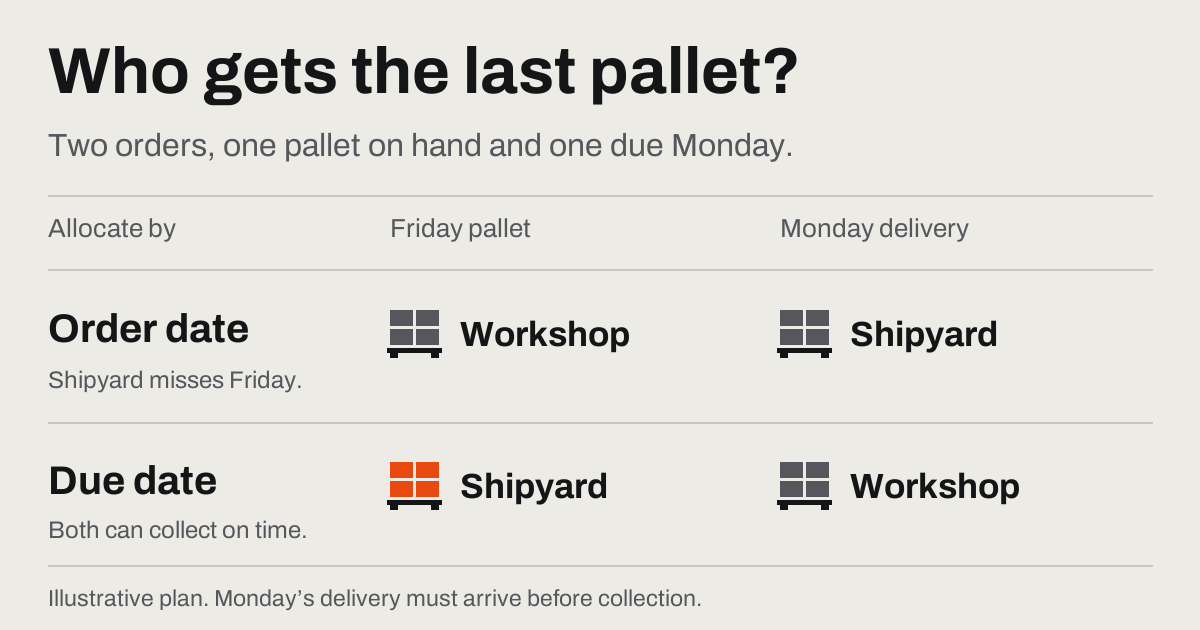
Illustrative stock decision. Both plans assume the same orders and delivery date.
The most useful thing the twin might show is the risk in the better-looking plan. If Monday’s truck slips to Tuesday, the workshop loses its slot. A dispatcher who knows that supplier would want to see its recent delivery record before releasing the pallet. And if the workshop paid to reserve that specific stock, the dispatcher needs its agreement. A good comparison keeps those facts attached to the recommendation.
Where we’re taking Operator
At Four Labs, we want to build Operator around decisions like this. We’d start with the person who allocates stock, connect the records they use and write down which promises they have the authority to change. Then we’d replay past orders using only what the team knew at the time. We could compare an alternative rule with what the team actually did, including the Fridays when holding the pallet was the right call.
For a live trial, the dispatcher would review the proposed swap. Only after approval would Operator change the reservation and check that the warehouse system recorded it. We’d track orders ready by their promised collection time alongside emergency freight costs. Buying an expensive replacement every Friday could make the first number look good while making the business worse off.
Our engagement starts with one recurring decision. We agree with your team on the baseline and the review period up front, and tie part of our fee to the measured result. If you run a distributor, bring us a week of orders and the stock records that went with them. Start with the order your team still argues about. How Four Labs works
Key terms
- Exponential Time Hypothesis (ETH). The idea that even the best method for solving the hardest 3-SAT puzzles would take exponentially more time as the number of choices grows.
- Business optimization. Choosing the plan that best meets a goal within your limits, such as filling the most orders on time with the stock you have.
- Digital twin. A working model linked to business records where a team can try a change before committing to it.
- Inventory allocation. Deciding which customer gets the stock available now and which order can wait for the next delivery.
- Project
- Insights
- Section
- AI in Practice
- Written by
- The Four Labs
- Updated
- 7 Nov 2026