AI Explained / 4 min read
Faster Business Decisions, With Clear Limits
How System One AI could help route enquiries and service requests, with defined choices, confidence checks and human review.
A customer asks for an update. A new enquiry needs the right salesperson. A service request might need urgent attention.
Each needs a small decision before anyone can move forward. Repeated across a busy day, those decisions become queues, interruptions and work that falls through the cracks.
AI systems designed to make quick, focused decisions could help keep that work moving. The business sets the limits on what the AI can decide.

A sorting metaphor with a separate tray for messages that need human review.
Fast and slow thinking
Psychologist Daniel Kahneman popularised two ways of thinking in Thinking, Fast and Slow.
System 1 is fast and intuitive. System 2 is slower and more deliberate. Kahneman also showed how quick thinking can be biased or mistaken. About Kahneman's book.
Think of an experienced service coordinator. Recognising a routine booking request may take a moment. Deciding how to handle an unusual customer dispute needs more thought.
TypeSafe draws on this distinction in its name System One models, a class of AI designed for fast, focused judgements. The name reflects that inspiration; it makes no claim that the software thinks like a person. TypeSafe's explanation of System One.
Choose from answers the business defines
Imagine asking AI where a customer message should go. The business defines the available choices: Sales, Service or Human review.
The model reads the message and selects from those choices. Software can then use the result to route the work. There is no written reply to interpret at that step. TypeSafe's models are built for this kind of structured decision. How the approach works.
TypeSafe reports responses in less than a second in its launch announcement. Four Labs has not independently benchmarked those results. A complete business workflow would need its own speed test. Read the announcement.
For a business, speed becomes useful when it shortens the wait for the next step. A request could reach the right queue while a team member is still working on the previous one.
The limits of “zero hallucination”
In everyday AI conversations, a hallucination usually means something made up, such as a fact or reference.
TypeSafe uses the term to mean that its model stays within the answer structure and choices supplied to it. In our routing example, it cannot invent a fourth department. The announcement explains this guarantee.
It can still choose the wrong department. TypeSafe's documentation makes clear that its uncertainty measures do not guarantee correctness for an individual decision. The business still needs to supply good information, set rules and test the results. What the model's probabilities mean.
Give uncertainty somewhere to go
The model's confidence signal can help the surrounding software decide whether to proceed, gather more information or ask a person. Those boundaries should be tested on the business's own examples. A confidence score alone is not permission to act. TypeSafe's guidance on confidence.
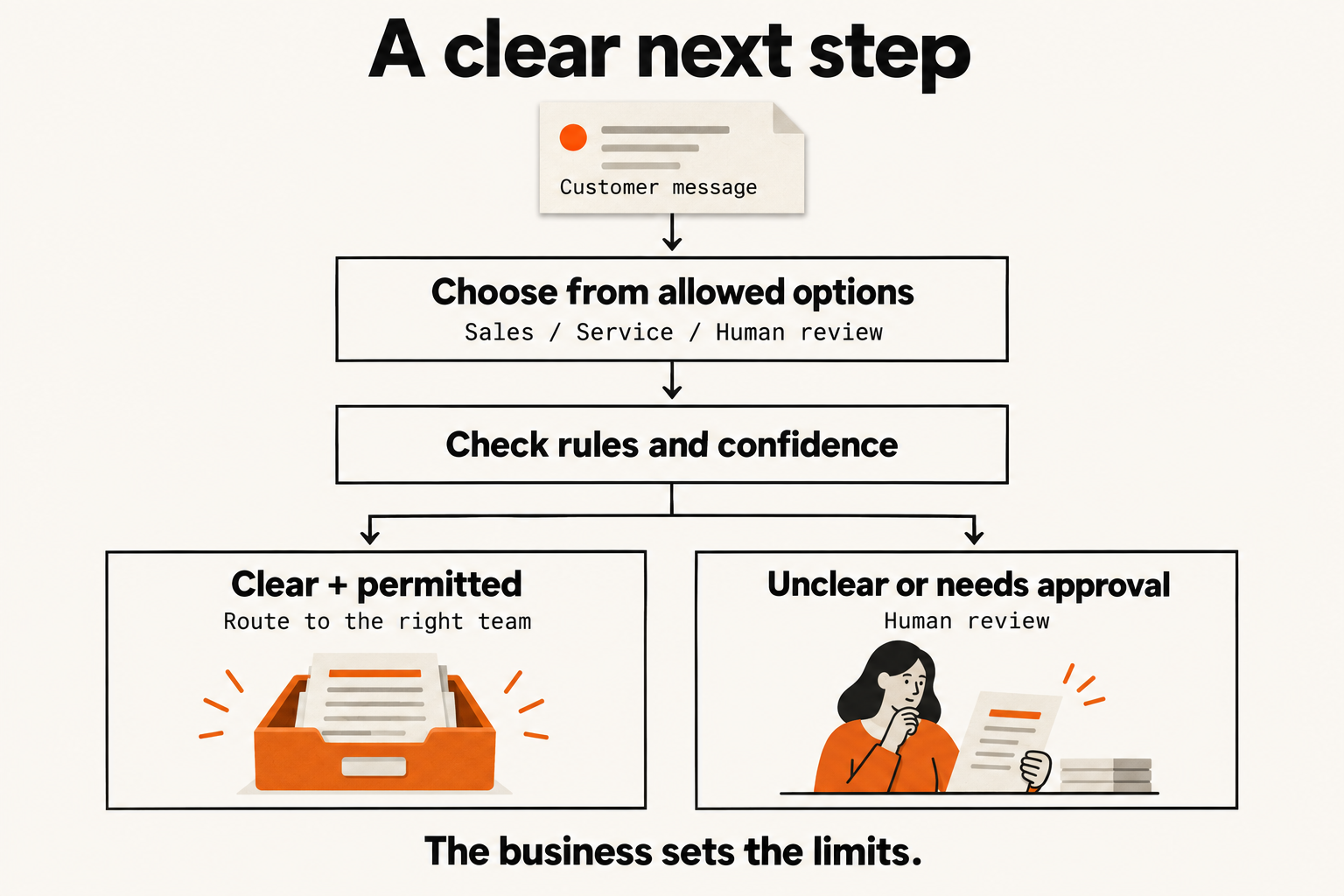
An illustrative workflow. The business decides which actions are allowed and when a person must be involved. Select the image to enlarge it.
For example, routing an enquiry could happen automatically. Offering a refund or making a delivery commitment could require approval, even when the AI is confident.
Where this could help first
- Sales enquiries: separate new quotation requests from questions about existing orders, so each reaches the right queue.
- Service requests: flag messages that appear urgent for a coordinator to review sooner.
- Document intake: identify whether an incoming text document belongs with purchasing, finance or customer service, with an exception queue for unclear cases.
These examples describe possible uses. Each would need testing against real messages and documents, including incomplete information and unusual wording.
The measures can stay simple: how long work waits, how often it reaches the wrong place, and how much checking the team still needs to do.
The Four Labs perspective
Our starting point would be one recurring bottleneck. Define the available choices, agree when a person should step in, and try a working prototype against examples the team understands.
If it reduces waiting without creating more correction work, there is a practical case for taking it further. That is what we want a prototype to demonstrate before a business pays for implementation.
Original AI-generated illustrations prepared for The Four Labs. They depict the routing examples described here.