AI Explained / 4 min read
AI, a Glass of Water and a Million-Dollar Maths Problem
What OpenAI reported about Navier-Stokes, why a fluid's mathematical description can break down, and how the AI-produced proof was checked.
Stir a glass of water and watch the little whirlpool. Something so ordinary hides a question that has challenged mathematicians for decades: can the equations describing a fluid's motion reach a point where their smooth solution breaks down?
On 8 September, OpenAI announced that an internal AI system had produced a proof answering that question for a particular case of the Navier-Stokes problem. It released a paper and a version of the proof written for computer checking. Read OpenAI's announcement.
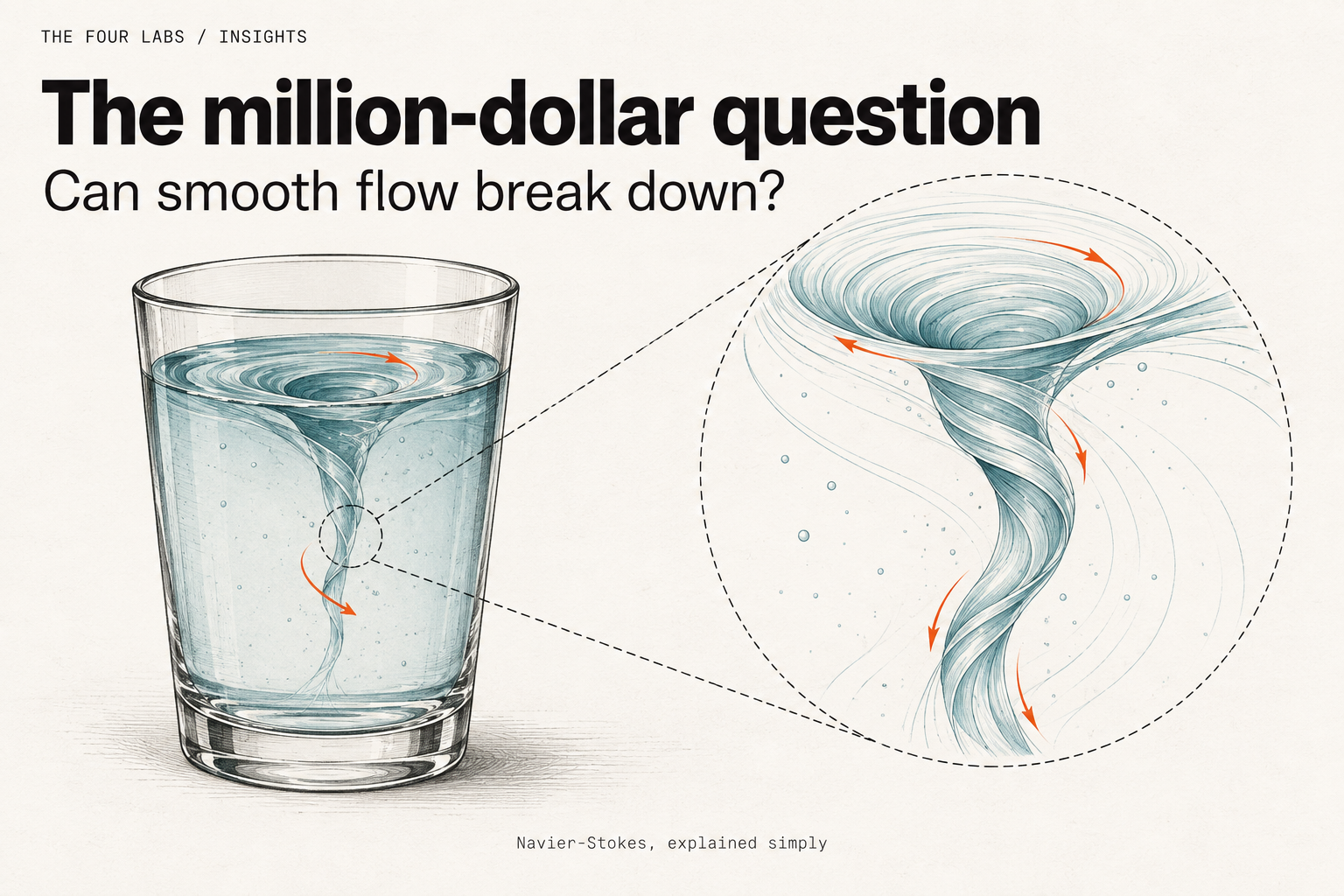
An everyday swirl is a way into the question. This illustration does not depict the special flow constructed in the proof.
The equations behind moving water
They are mathematical rules for how fluids move. Water is a fluid. So is air.
Instead of following every molecule, the equations describe quantities such as velocity and pressure across the fluid. You can think of them as a continuously changing map of how fast things are moving, in which direction, and how they push on one another.
Three ideas make the motion easier to picture:
- Carried along. A leaf floats down a river with the current. The fluid also carries its own motion from one place to another. The technical word is advection.
- Pushed around. Differences in pressure push fluid, as in water moving through a pipe.
- Smoothed out. Neighbouring layers moving at different speeds tug on one another. This is viscosity, which tends to reduce those differences.
External forces, such as gravity or a stirring action, can also influence the flow. In the incompressible version considered here, a small parcel can change shape while keeping its volume. See the official mathematical formulation.
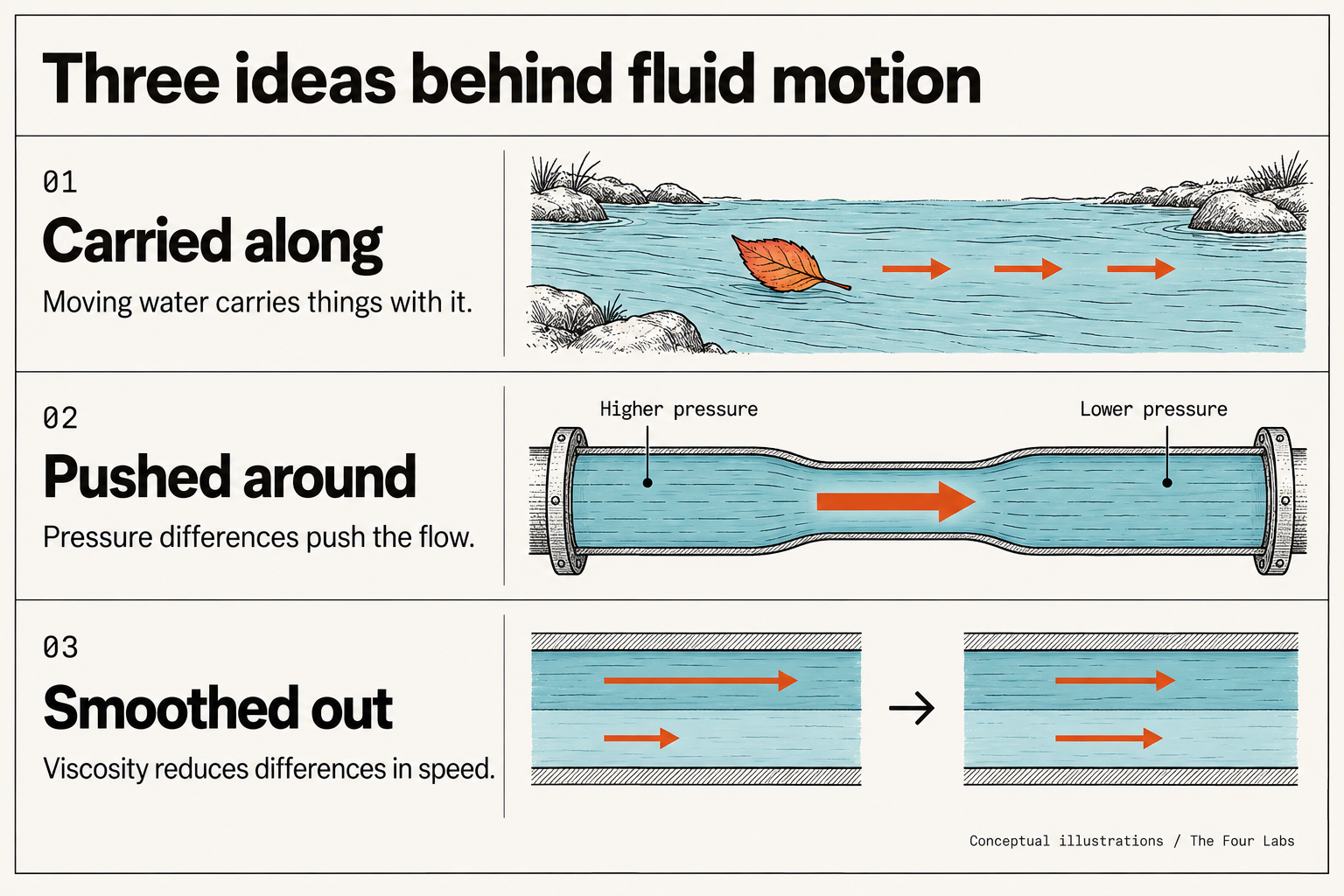
Carried along, pushed around, smoothed out. Conceptual illustrations; select any image to open it at full size.
The million-dollar problem
Computers already use these equations to simulate fluids. Making a convincing simulation and proving what the equations must do in every permitted case are different tasks. Károly Zsolnai-Fehér's fluid-simulation research offers a useful introduction to the simulation side.
The prize problem concerns three-dimensional flow. Roughly: if the starting conditions are smooth, must the solution remain smooth for all future time, or can a permitted case develop a mathematical breakdown?
Here, “smooth” means mathematically regular, which describes the solution rather than how calm the water looks.
In 2000, the Clay Mathematics Institute included this among seven major problems, allocating US$1 million to each. About the Millennium Prize Problems.
The flow OpenAI's system constructed
The reported construction begins with a fluid at rest and applies a carefully chosen, smooth external force.
A vortex forms. Fluid spirals inward and moves outward along the vortex's axis. The region of intense motion becomes smaller and thinner, while its speed grows without bound as a particular time approaches. Its total kinetic energy nevertheless stays finite because the intense motion occupies a shrinking region. OpenAI's paper, introduction and physical description.
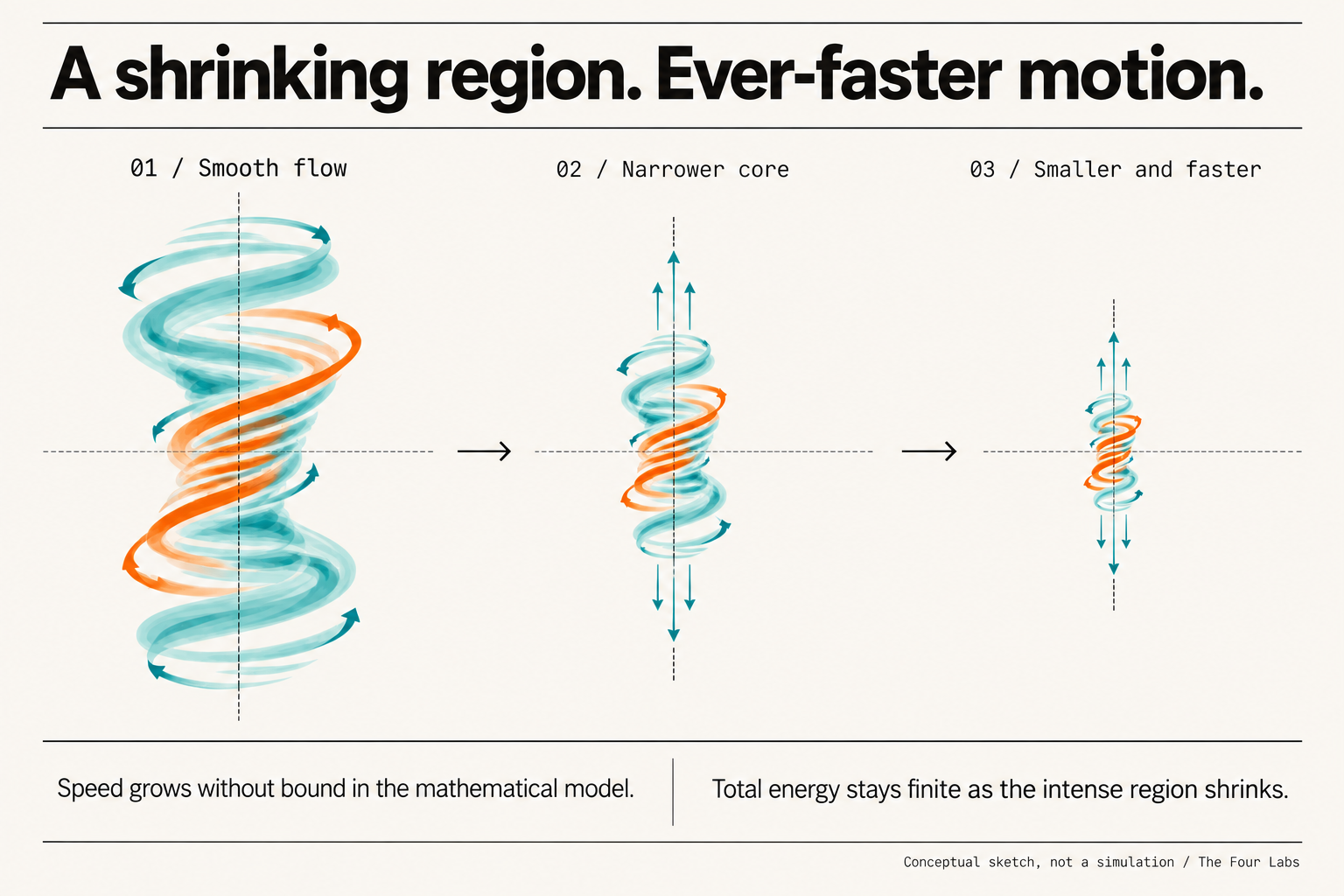
A simplified sketch of the shrinking active region. The shapes are illustrative, with no measured scale; this is not a numerical simulation.
That mathematical breakdown is called a singularity. It does not mean a real glass of water suddenly moves infinitely fast. It identifies a limit of the smooth mathematical description.
The result addresses the breakdown alternatives, labelled C and D, in the official problem statement, which allow an external force. It does not establish the same result for Navier-Stokes flow with no external force. The released proof repository summarises the scope.
How the proof was checked
The group that found the result involved roughly 10,000 AI agents, according to OpenAI. The proof emerged about 88 hours after the effort began, followed by another 17 hours for formalisation and verification using GPT-6 Astra. The discovery system used a more capable internal model. OpenAI's account of the process.
The released formalisation uses Lean, software that checks mathematical reasoning written in a precise language. This gives others a concrete proof to inspect and run through a checker. Proof files and checking instructions.
A published proof and a prize award are separate milestones. Clay's rules require qualifying publication, at least two years, and general acceptance by the mathematics community before consideration. OpenAI says it does not intend to claim the prize. Clay's rules · OpenAI's statement.
The Four Labs perspective
In business software, we can give AI a specific task and define how to check its output.
For example, an invoice workflow could extract the line items, calculate the total independently, compare it with the document, and flag any mismatch for a person to review. A document assistant could show the passage supporting its answer.
Those checks are much narrower than a mathematical proof. They give a team a way to inspect the work before relying on it. At The Four Labs, we test a working prototype against criteria agreed with the business.
Watch and explore
The starting point for this article was the Two Minute Papers explainer, “I Never Thought I'd See This Happen”. For the result itself, read OpenAI's announcement, the linked paper and proof files.
Original AI-generated illustrations prepared for The Four Labs. They explain concepts and are not evidence from the proof.