AI in Practice / 5 min read
OpenAI’s Maths Results and the Next Step for Operator
OpenAI’s latest maths release points to stronger AI reasoning. For Operator, the next step is turning that ability into business work people can check.
OpenAI’s latest maths release gives us a stronger reason to test AI on work that needs sustained reasoning. It also raises the standard we should set for the systems built around it.
For Four Labs Operator, the opportunity is to help a business work through more demanding requests, with enough evidence for a person to check what happened. A model’s ability to produce a difficult mathematical argument makes that direction more credible. We still have to prove it on the work a business needs done.
What OpenAI released
On 6 October 2026, OpenAI published mathematical results from an internal frontier model. The release includes manuscripts, supporting materials and computer-checkable proofs for part of the collection.
As checked on 13 October, its public repository lists 719 manuscripts in 372 families of related work. A family can contain a main result, supporting arguments, consequences or alternative proofs. Reading “719 papers” as “719 separate open problems solved” would overstate the release.
OpenAI says the model was given roughly 4,000 problems during the evaluation. Its announcement puts the average compute per result at about three hours of ChatGPT Pro thinking. That describes computation, rather than a three-hour turnaround anyone can expect from today’s ChatGPT. The model used for most of the work remains unreleased.
How far forward does this take AI?
In our view, this is a substantial step in AI’s capacity to reason through difficult problems. An open research problem has no generally accepted solution. Producing a candidate proof means doing work that researchers can examine, challenge and build on.
The breadth of this release gives researchers much more to examine than a single demonstration. If the central claims survive scrutiny, the implications extend to how researchers find approaches, develop arguments and check their work.
Better reasoning could help AI follow a business request across several records, notice a conflict and work out what information is missing. These are tasks that often keep an experienced employee at their desk after a message has arrived.
That is a hypothesis to test. This maths release does not measure whether AI can reconcile your invoices, interpret your shift rules or handle your customers reliably. Each workflow needs its own evidence.
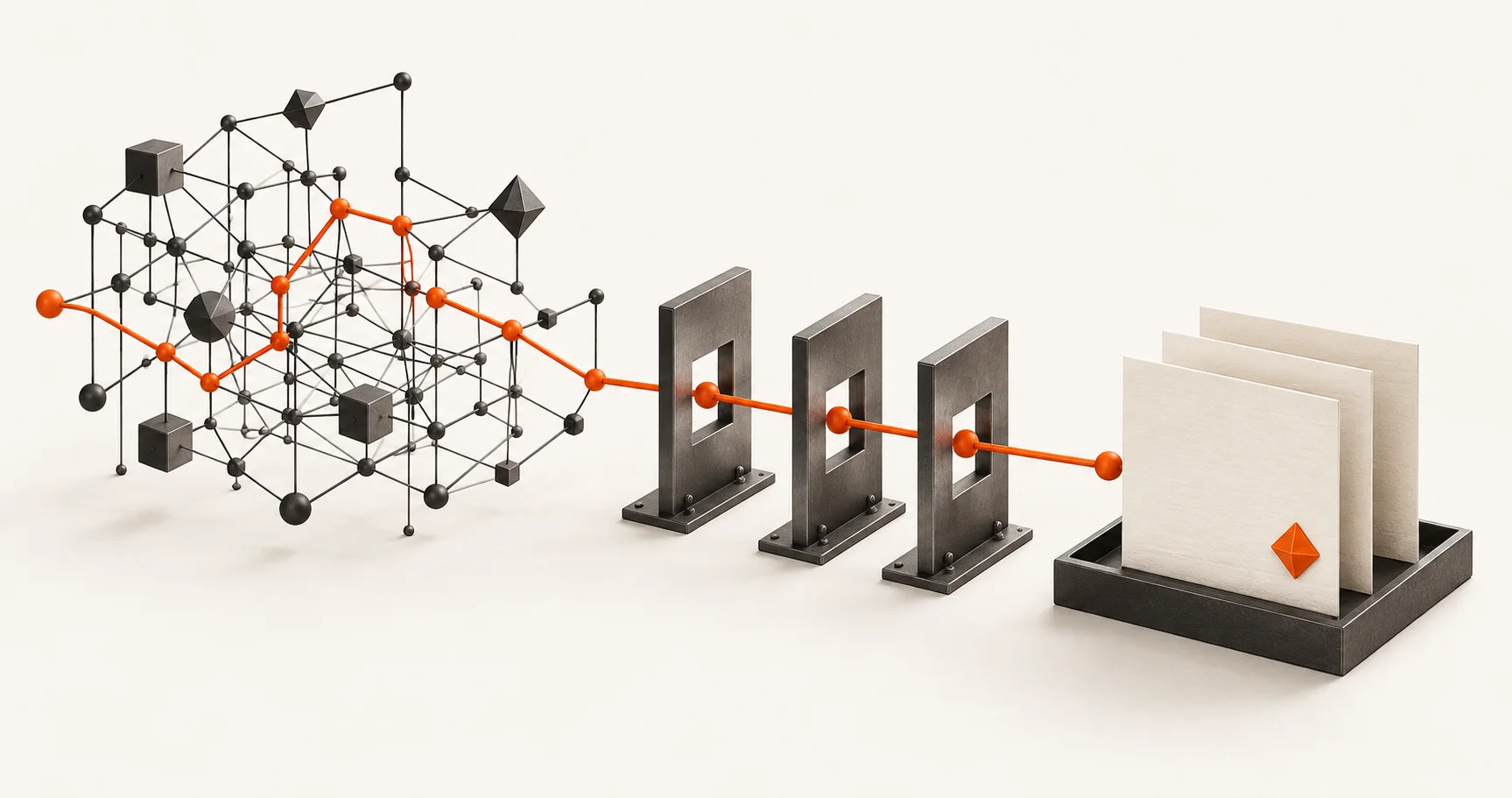
Original AI-generated editorial illustration. The checking frames represent review steps; this is a conceptual image, not a mathematical proof or a working Operator screen.
Checking the work is part of the advance
The release also shows how much checking remains. OpenAI’s repository says roughly 42% of its top-line results have Lean formalizations, and warns that unformalized results may contain issues.
Lean is a language and theorem prover used to write mathematical statements and proofs that a computer can verify. It checks the formal argument within its stated assumptions. People still need to examine whether the formal statement matches the intended claim and understand how to use the result.
The collection has already changed. In its 7 October revision history, OpenAI records the withdrawal of three manuscripts after a sign error invalidated an argument used across them. It also records repairs and clarifications to other papers.
The independent Advisory Group on Mathematics and Artificial Intelligence says its advice to OpenAI should not be read as an endorsement of the results or the release process. It places the assessment with the mathematical community. Publication begins that work.
Business software should keep the proposed answer, the checks and the accepted result visible. When an error appears, record the correction and identify any work that depended on it.
What this means for Operator
Operator is the business workflow product we are building at The Four Labs. Stronger reasoning models could widen the range of requests it can help with. The product still needs to control access, apply the business’s rules and show whether an action succeeded.
Consider an illustrative supplier invoice workflow. An invoice arrives for a job, but its quantity differs from the delivery record. A capable model could compare the documents, describe the mismatch and prepare a question for the person handling the delivery.
The workflow can check the supplier against the company record, recalculate line totals and look for a duplicate invoice. It should identify the document behind the quantity and route approval to an authorised person.
Other parts need judgement. The goods might have arrived in two deliveries. The supplier might have used an old job reference. The model should be able to explain what it found and leave the unresolved part with someone who can decide.
Once an approved change is made, the workflow should read the record back from the destination system. A message saying “done” is insufficient evidence that the invoice was saved correctly.
These are design and testing requirements for Operator. The maths announcement does not establish that this example is a finished feature, or that Operator uses the unreleased research model.
Start with a task whose result you can inspect
For a business considering AI, this is a good time to choose one recurring task and define what a correct result looks like. Keep the original request, the records used, the proposed action and the final outcome together.
Test ordinary cases alongside missing documents, conflicting figures, duplicate requests and people asking for records they cannot access. Measure completed work, corrections and time spent reviewing it. A faster draft helps only if checking it does not consume the time saved.
We want to develop Operator with businesses by agreeing on one task, testing it against their records and expanding only when the results support it.
Research checked on 13 October 2026. The OpenAI collection is under revision; counts and verification status may change.