The Organizational Singularity: Why Your Business Needs More Than AI Tools
A WhatsApp sales enquiry shows how AI workflow automation can help a small business check stock, route quote approvals and follow up with customers.

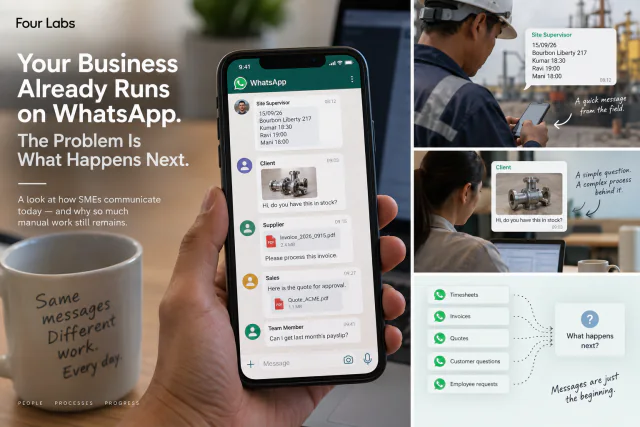
A sales enquiry lands in WhatsApp at 9 a.m. AI can draft a reply in seconds. The customer still waits until tomorrow.
What happened in between? Someone had to check stock, find the latest price, ask who could approve an exception, and remember to send the reply. Drafting got faster. The customer’s wait didn’t.
That difference is why we’re building Operator at Four Labs. For a small business, the opportunity in AI workflow automation is to connect those handoffs. A salesperson needs enough information to give the customer an answer they can stand behind.
The coordination tax in business workflows
In The Organizational Singularity, Salim Ismail argues that AI changes what it costs for a company to coordinate work. If software can notice what happened, gather relevant information and move work to the right person, leaders can rethink how the work is organized in the first place.
That’s more useful than asking every department to find a way to use AI. A finance team can generate a report in five minutes and still spend three days waiting for inputs and sign-off. A sales team can write twice as many drafts and still miss follow-ups because nobody owns the queue after the meeting ends.
Before you buy another tool, follow one real piece of work from start to finish. Note when someone has to chase an answer, copy information between systems or wait for a decision. That’s the coordination tax. It’s rarely visible in a demo that shows one task getting done faster.
How to automate a sales enquiry workflow
Ismail’s ExO 3.0 framework starts with a clear purpose, describes an Intelligence Stack for putting information to work, and proposes a method for rewriting one workflow at a time. Here’s how we’d apply those ideas to a small business.
- Give the workflow a clear outcome. For a distributor, that might mean giving customers a reliable answer the same day, without promising stock the business can’t deliver. The outcome gives the team a way to judge when automation is helping.
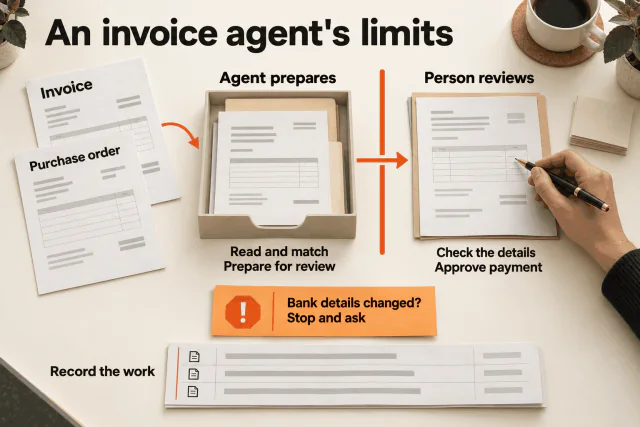
- Decide what AI can check, do and hand off. The workflow can gather product and inventory information, identify missing details, and prepare a recommendation. Set human approval rules for exceptions. Name the person who can make a substitution, grant a discount or commit to a delivery date.
- Change one workflow before you change the company. Start with WhatsApp enquiries for one product category. Track the time to a verified response, the number of handoffs, and how often someone has to correct the recommendation. Expand only if the workflow is faster without becoming less reliable.
Building Operator for sales follow-up
We’re building Operator so a team can give AI a responsibility, with a clear owner, access limits and approval rules. Imagine a salesperson setting up an AI agent for sales follow-up, choosing which leads it should watch and when it needs human approval. Operator would check in the background, flag a lead that needs attention, explain why and prepare a follow-up. The salesperson would see what happened and decide what should go out.
The goal is for the person who owns the work to be able to turn it on, see what it’s doing and pause it in one place. If something needs approval, they should be able to see who needs to act and why. If the agent doesn’t have access to the right information, it should say so rather than guess.
At Four Labs, we want work to keep moving without someone having to remember every next step. The team should still be able to see and control what happens.
Pick one piece of work your team had to chase last week. Write down where it started, who had to touch it, and what counted as done. If most of the time was spent waiting between steps, that’s a good first workflow to rethink.
- Project
- Insights
- Section
- Business Operations
- Written by
- The Four Labs
- Updated
- 22 Nov 2026